
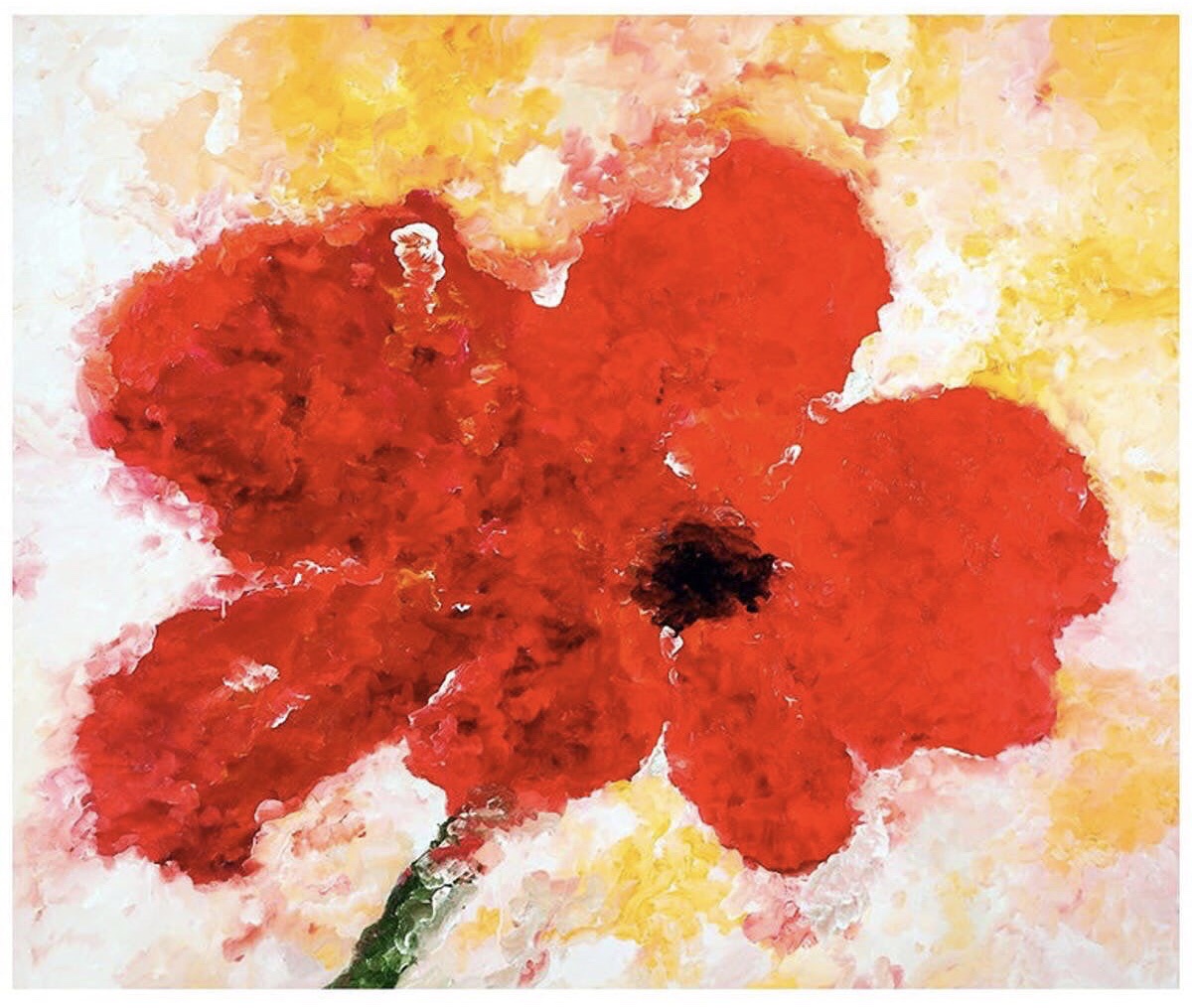
Flower in red
€400
- Armando (1929-2018)
- Giclée on paper, E.A.
- Signed in lower right
- 60 x 70 cm
- Framed
Sold
Herman Dirk van Dodeweerd (1929-2018), known as Armando, is a Dutch painter, sculptor and writer. He was born in Amsterdam but he moved to Amersfoort during the Second World War. After the liberation (1945), he studied art history at the University of Amsterdam. His first solo exhibition was held at the Galerie Le Canard, Amsterdam, in 1954. In this period he also started to write poetry. His paintings and drawings were influenced by the CoBrA art group and Debuffet. In 1958 he was one of the founding members of the ‘Nederlandse Informele Groep’.
After joining the Situationist International (SI), he attended their conference, held in Munich in 1959. He wrote, along with Anton Alberts, Constant and Har Oudejans, the First proclamation of the Dutch Section of the SI. Although he was expelled from the SI in 1960, he proceeded to contribute to other Situationist publications like the Situationist Times. He also contributed to Podium, Gard Sivik, De Nieuwe Stijl, and Barbarber.
He lived in Amsterdam, Amersfoort and until 1989 also in Berlin. On 22 October 2007 a large fire struck the Armando museum in Amersfoort and burned thirteen Armando paintings. Since 2014 the Armando Collection found a new home in the Museum Oud Amelisweert near Bunnik (NLD). The MOA frequently organises exhibitions, featuring works of Armando and works of other artists.
Armando was one of the most famous Dutch artists to come out of the international Zero movement or ‘Nul-beweging’ (Dutch). Much of his work was based in his experiences during WW II near camp Amersfoort. Armando was also an active media-personality, violin player, journalist and active in television as well as theater productions.
