
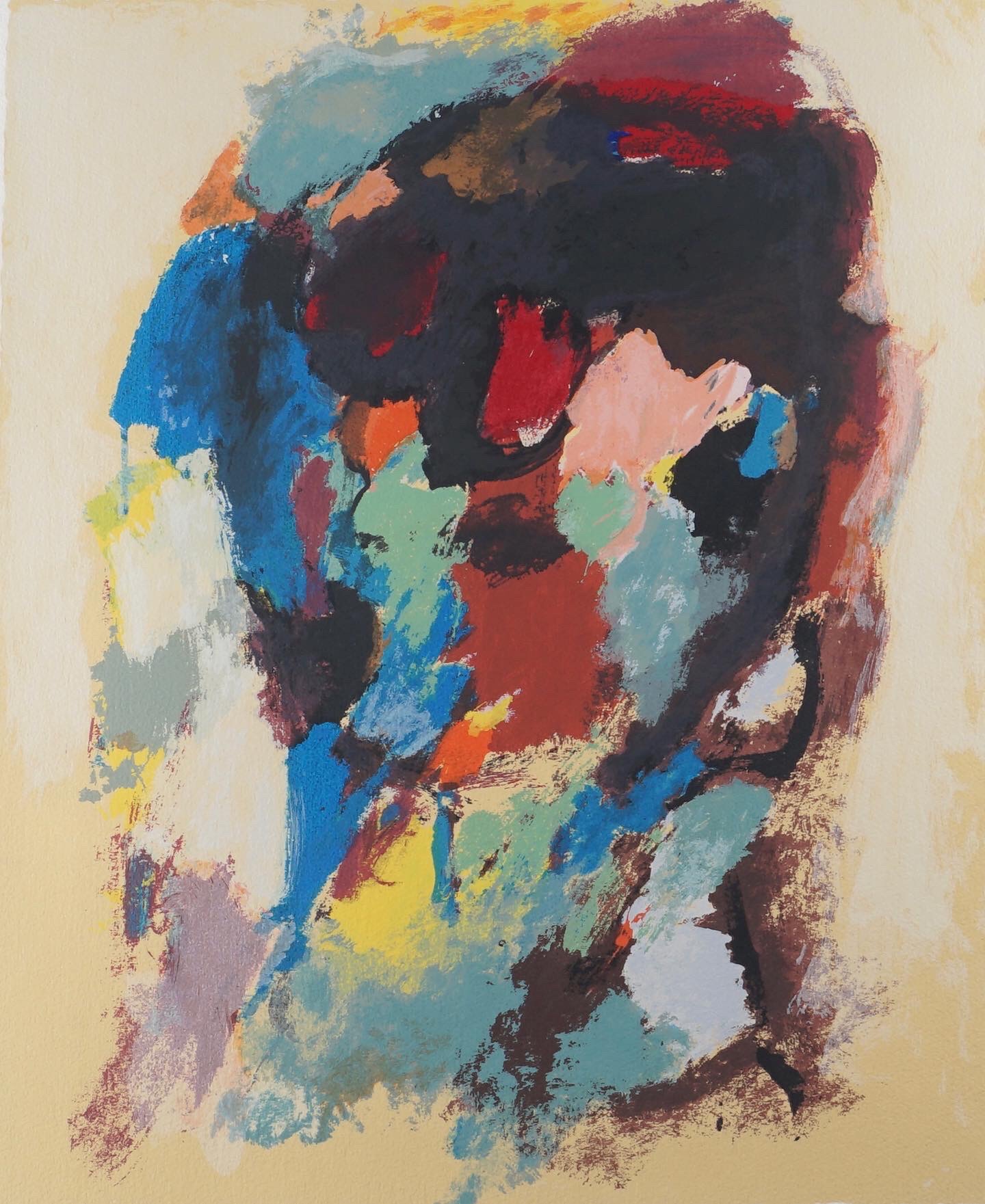

The Gardener
€450
- Eugene Brands (1913-2002)
- Silkscreen, 29/200
- Signed in lower left
- 90 x 70
- Framed
Sold
After Eugene Brands (1913-2002) had worked for a number of years as an advertising artist, he decided to start painting. The artist was self-taught. During the war he experimented with drip-paintings, which he called ‘cosmic art’. These expressions of imaginary constellations are surrealistic drawings in ink on paper, which are created randomly by means of flowing, smudging and splashing.
In 1946, during the ‘Young Painters’ exhibition in Amsterdam’s Stedelijk Museum, he attracted attention with his Deksel des hemels (The lid of heaven), a pan lid filled with white paint splashes depicting a galaxy and handles in the shape of a rainbow. Karel Appel, Anton Rooskens and Corneille, impressed by Brands’ playful artistic expressions, asked him to join the experimental group REFLEX, which shortly afterwards merged into the CoBra movement.
What unites these painters is the fierce desire for a free, spontaneous mode of expression. However, after the famous CoBra exhibition in 1949, Brands decided to leave the group. He is more inclined to be a solitary artist. For the next ten years he retreats into his studio, drawing inspiration from his daughter’s drawings. He paints in a lyrical-abstract style with a wooly appearance, which is characteristic of his entire oeuvre.
After his first solo exhibition in Amsterdam in 1939, Brands took part in many national and international solo and group exhibitions, e.g. at the Salon Realites Nouvelles in Paris. 1962 he saw his definitive breakthrough with an exhibition organized by Willem Sandberg at the Stedelijk Museum. From 1967 Brands taught at the Royal Academy of Art in Den Bosch.
Brands lived and worked in Amsterdam. From 1974 he moved into a summer residence where, because of the proximity of nature, he feels even more connected to the mystery of the cosmos. This silkscreen work stems from that later period in his life. He died in 2002, on the day of his 89th birthday, in his studio in the south of France.
