
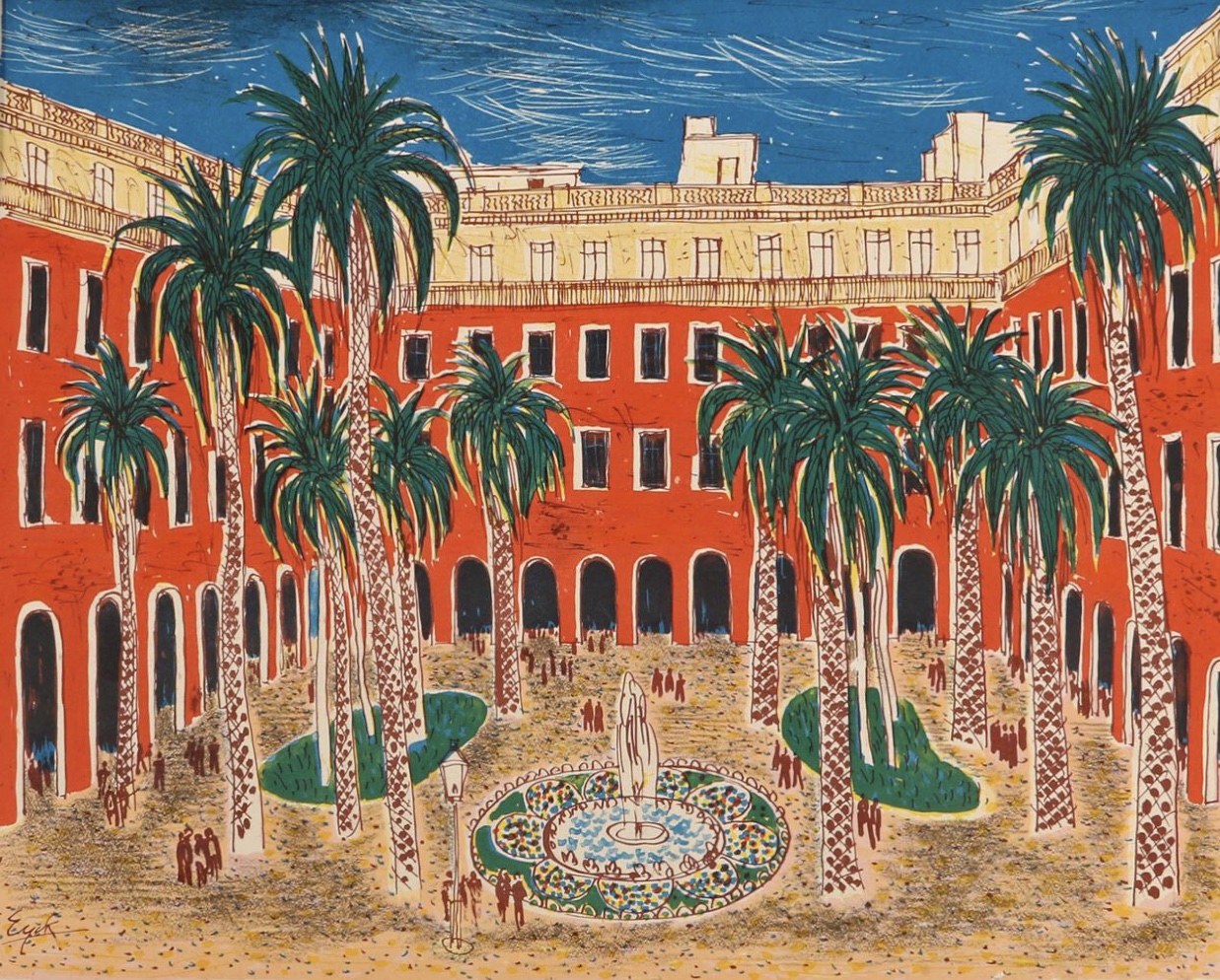
Patio, 1947
€350
- Charles Eyck (1897-1983)
- Lithograph, no. 8
- Signed and dated
- 60 x 70 cm
- Framed
Sold
Charles Eyck (1897-1983) was the fifth in a family of fourteen children. At the age of ten, he became deaf as a result of an illness, which forced him to discontinue his schooling.
Because of his passion for drawing and because in the large family it is considered necessary for him to contribute to the family income, Charles was sent to the Maastricht pottery factory, where he decorated cups and saucers. In the evenings he took drawing lessons with Jos Tilmans, teacher and plate painter.
At the age of 21, Charles studied at the Rijksacademie voor Beeldende Kunsten in Amsterdam. During this period he was strongly influenced by A. Derkinderen, known for his monumental wall and glass painting.
In the early 1920s, he undertook study trips to southern Europe. In 1929 he began to have tentative successes in Paris and received his first commission for a church mural for the church in Rumpen, upon which the family returned to the Netherlands.
In the thirties he began to gain greater fame and in 1938 Charles settled in the house ‘Ravensbos’, designed by himself, between Valkenburg and Schimmert.
During World War II, he refused to join the Kulturkammer and, of necessity, traded drawings for essentials of life. Colleagues from the Randstad also went into hiding with him in ‘Ravensbos’.
After the war he worked mainly as a glazier in the many damaged churches and designed many resistance monuments. In the 1950s he vigorously opposed new art movements and made inspirational trips to Spain, France, Greece and the Dutch Antilles.
In 1955, he was appointed professor at the Jan van Eyck Academy, but after disagreements with the director, including about housing, he resigned after a year.
Until his death in 1983, he remained active as a painter and draughtsman, but he had turned away from the contemporary art world and led a reclusive life on “Ravensbos”. However, he also continued to write letters to anyone with whom he wished to exchange views. Given his deafness, writing was a very important means of communication for him which he therefore constantly and frequently used.
