
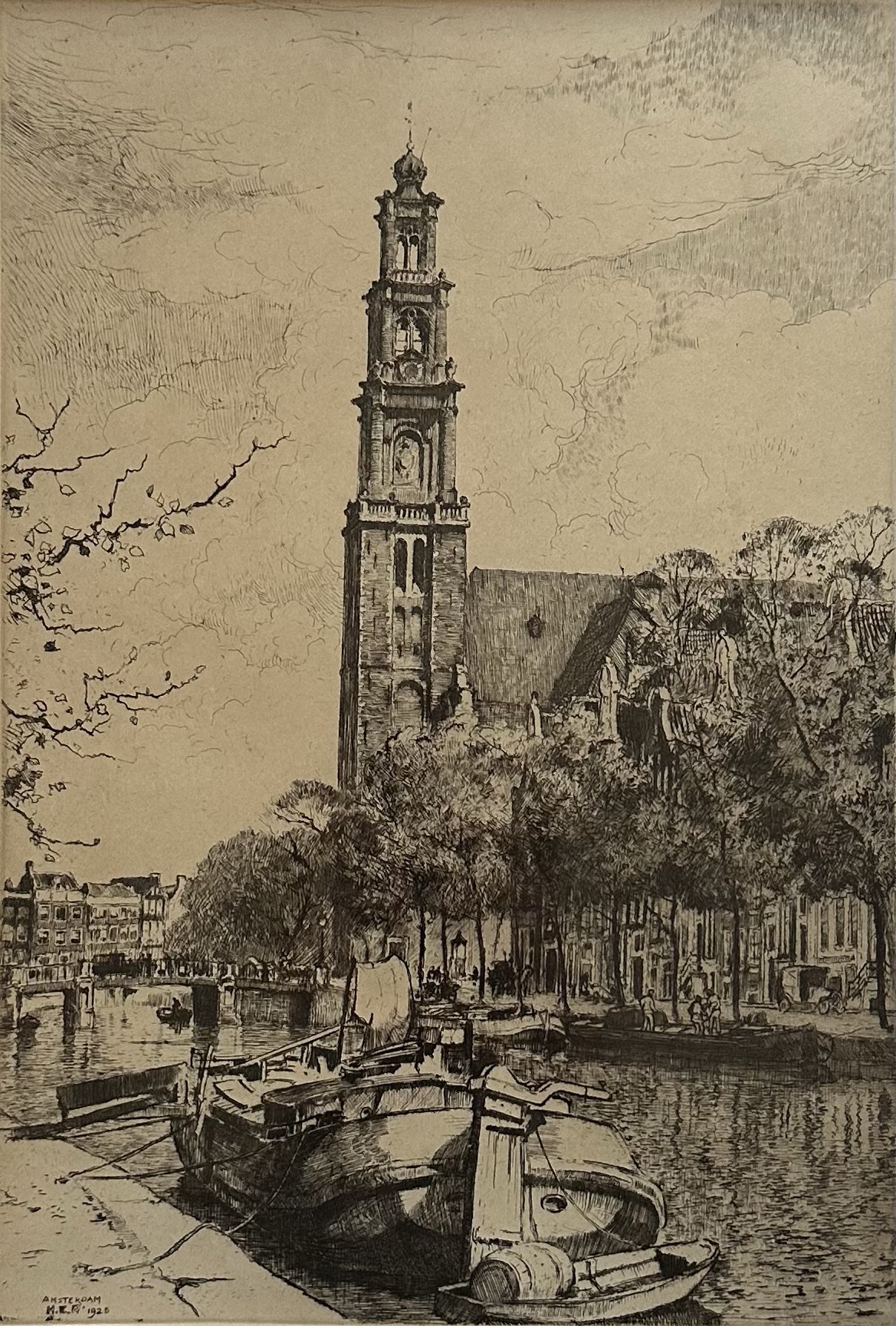
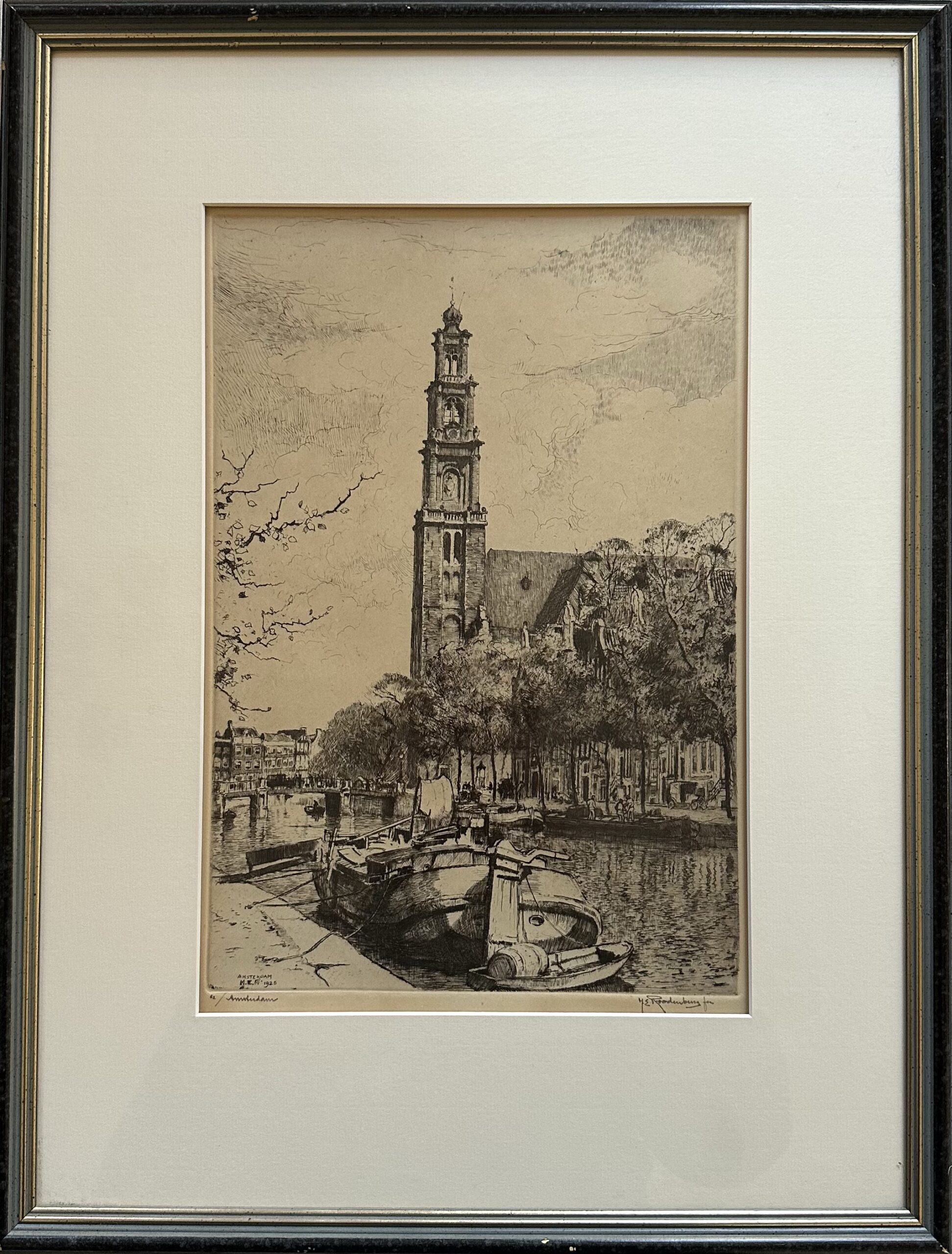
Westerkerk in Amsterdam, 1925
€245
- H. E. Roodenburg (1895-1987)
- Etching, 62
- Signed in lower right
- 60 x 40 cm
- Framed
Sold
Hendrikus Elias Roodenburg’s etching of the Westerkerk in Amsterdam captures the grandeur and historical significance of this iconic Dutch church. The etching showcases the intricate architectural details of the Westerkerk, including its towering spire and ornate facade. Roodenburg’s masterful use of light and shadow brings depth and dimension to the scene, highlighting the church’s prominence in the Amsterdam skyline. The etching not only serves as a testament to Roodenburg’s skill as an artist but also as a tribute to the rich cultural heritage of Amsterdam.
Roodenburg’s etchings are characterized by meticulous attention to detail and historical accuracy. He often employed the aquatint technique to create depth and shadow, adding a rich texture to his works. His depiction of the Westerkerk is no exception, capturing the architectural and urban essence of the church with precision and artistry.
In summary, Hendrikus Elias Roodenburg’s etching of the Westerkerk in Amsterdam exemplifies his skill in capturing the beauty and history of Dutch urban landscapes. This piece stands as a valuable record of Amsterdam’s architectural heritage and a testament to Roodenburg’s artistic prowess.
Hendrikus Elias Roodenburg was a Dutch painter and etcher. He learned his trade from the graphic artist Philippe Zilcken and became known for his city views of Amsterdam, Rotterdam, Gorinchem and Utrecht.
In the 1960s Nutroma offered the possibility of getting free tableware from Villeroy & Boch. On this set, Roodenburg’s black and white drawings of Amsterdam cityscapes were depicted.
Roodenburg was a member of several artists’ associations, including Arti et Amicitiae and Sint Lucas in Amsterdam and Pulchri Studio in The Hague. The book “H.E. Roodenburg (1895-1987): topographical etcher” gives an overview of Roodenburg’s graphic work. These great etchings are all represented in the catalog.
