
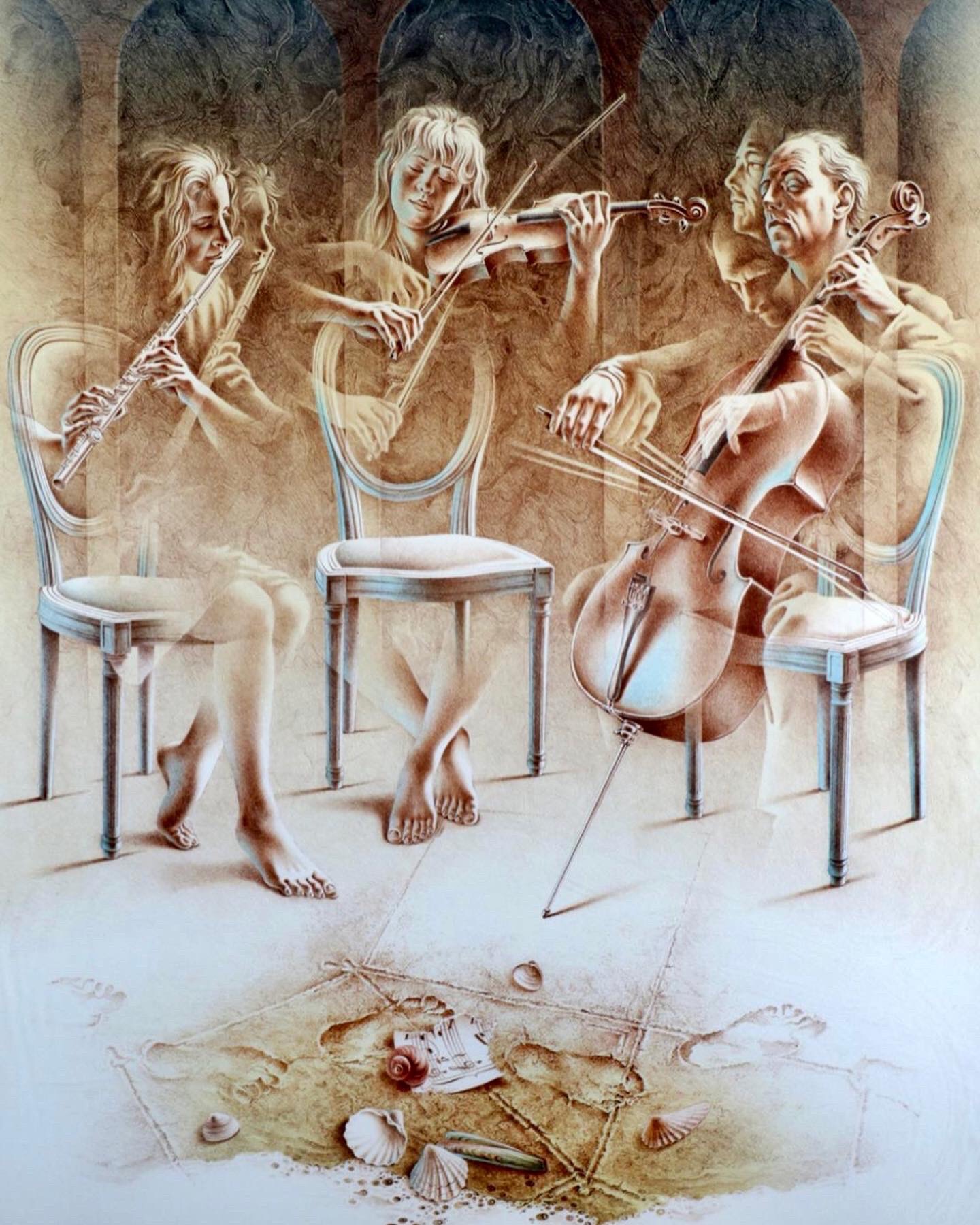
 Surrealistic music trio
€200
Available!
Available!
The work of Poen de Wijs (1948-2014) has developed from abstract to realistic. His first realistic watercolous date from 1977. Since then, he has built up an oeuvre of more than 800 works, initially in watercolour, then in oil and since 1999 in acrylic paint. He has also produced 30 editions in lithography. With his first realistic watercolours, Poen de Wijs became known in the Netherlands, especially because they were used for record sleeves of the band Flairck. His exhibitions at the Steltman gallery in Amsterdam (from 1979 to 1989) established his name definitively.
In a period in which abstract, experimental painting was at its height, the reactions to his work were very diverse. There were not many galleries that showed realistic work at that time and proponents and opponents wrote very different things. From 1990 onwards, his exhibitions were organized by gallery De Twee Pauwen in The Hague and gallery Bonnard in Nuenen. International exhibitions and presentations were held in Indonesia, Germany, Switzerland, Kenya, USA, Austria and Spain.
Poen de Wijs painted many thematic works: his love for classical music was expressed in the theme “Alma Musica” (1993). He has never limited himself to one and the same painting technique or shied away from experimenting with it; on the contrary, he has constantly experimented and discovered new techniques, possibilities and applications. He studied and practiced old painting techniques in order to integrate them into new possibilities. Thus, his realistic style evolved through the changes in the application of painting materials.
In 1999, Poen de Wijs stopped using oil paint and switched to acrylic. A new development in his work is the use of metallic paints in acrylics. He applies layers of gold, silver or copper paint over part of the underpainting. An observer sees two completely different images, depending on the angle at which one looks at the work of art. This metallic effect gives an almost three-dimensional effect.
© - All rights reserved.

Surrealistic music trioAvailable!