
 Composition 68, 1952
€875
Available!
Available!
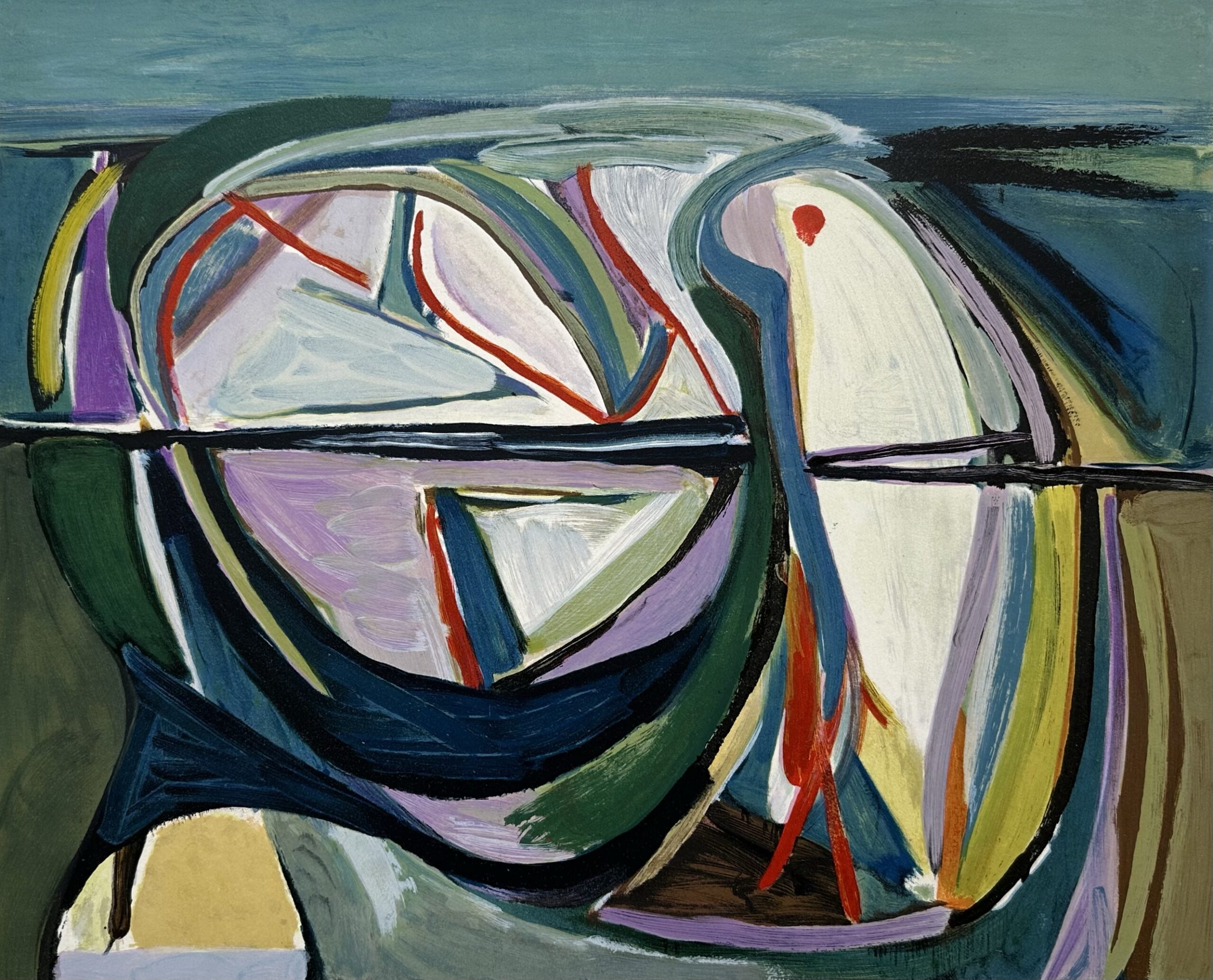
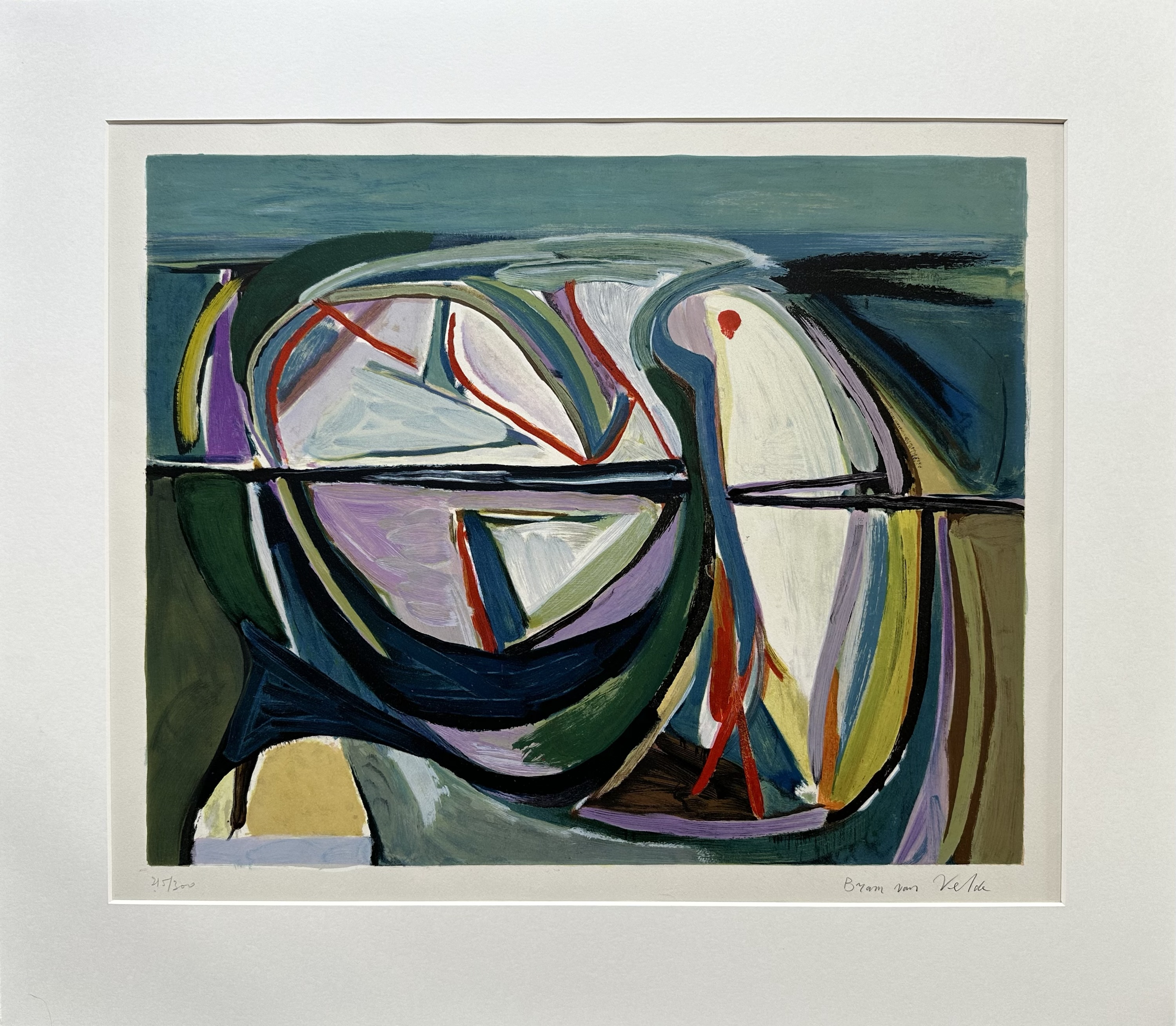
This lithograph by Bram van Velde is a vivid example of his abstract expressionist style, characterized by emotionally charged forms and a refusal to conform to traditional representation. The composition is dominated by a series of broad, looping shapes that interlock and overlap, creating a sense of movement and tension. These forms are set against a background divided by a strong horizontal axis, which bisects the image and may suggest a horizon line or some symbolic threshold between two states of being.
The color palette is both muted and striking. Soft teal and olive tones provide a calm base, while more saturated hues like deep purple, red, and black lend the work its emotional intensity. Light beige and cream areas serve as breathing space, allowing the viewer’s eye to rest amidst the more chaotic, dense forms. Van Velde often used color not just decoratively, but as a means of expressing inner states, and here the combination of warm and cool tones creates an atmosphere of melancholic introspection.
The forms themselves are ambiguous—neither fully abstract nor clearly figurative. They seem to evoke organic, perhaps even human shapes, without ever becoming literal. There is a distinct biomorphic quality to the image, with its curved lines and closed forms suggesting bodies or vessels. This ambiguity is a hallmark of Van Velde’s work, reflecting his belief that painting should convey emotion and existence rather than narrative or illustration.
Overall, the lithograph speaks to a tension between structure and chaos, presence and absence. The bold black contours that define the shapes offer some sense of containment, but the swirling inner lines and shifting colors suggest emotional turbulence. Like much of Bram van Velde’s work, it resists easy interpretation, instead inviting viewers to experience it on a more intuitive and emotional level.
Bram van Velde belongs to the older generation of abstract expressionists. He grows up in Zoeterwoude (near Leiden), in a working class family of four children. At the age of twelve, he gets a job at a home furnishing company, where he develops himself as a decorative painter. His employer notices his painting talent, and with his support Van Velde leaves for Germany, where he joins an artists’ colony.
In 1925, Van Velde leaves for France. He resides alternately in Paris, Corsica and Majorca, and lives there in misery and poverty.
After Wold War II, Van Velde has a number of exhibitions, but yet, without success. He still lives in great poverty and finds himself in an almost permanent state of depression. A successful sales exhibition in 1957 heralds a turning point in his career, eventually culminating in world fame. One year later – he is over sixty by then – he gets his first museum exhibition in the Kunsthalle Bern, followed in 1959 by an exhibition in the Stedelijk Museum Amsterdam.
In 1989, eight years after his death, the Bonnefantenmuseum and the Centre George Pompidou jointly organise a major retrospective of Van Velde’s work in Maastricht and Paris.
© - All rights reserved.

Composition 68, 1952Available!