
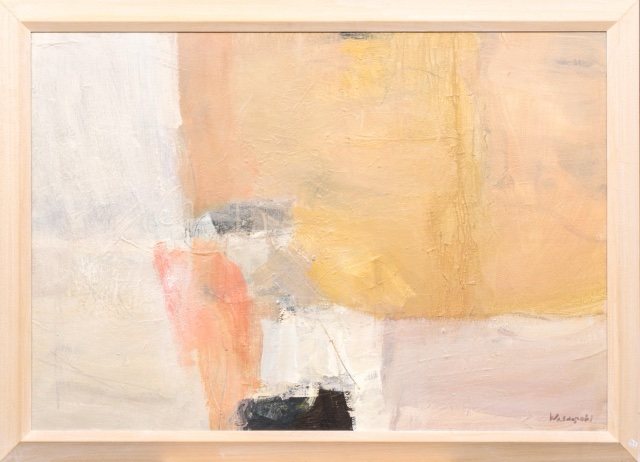
Abstract landscape
€575
- Rob Weddepohl (1934)
- Oil on board
- Signed in the lower right
- 68 x 98 cm
- Framed
Sold
Rob Weddepohl (1934) came from a business family, so that being an artist was not initially in his line, despite the talent that was already evident in his work from an early age. After studying Business Administration, he spent some years in Spain, where he had the opportunity to take painting classes at the Seville Academy. After his return to the Netherlands, he was an active member of the Apeldoorn artists’ association “de Bent”. However, his business activities forced him to give up his part-time artistic work until he was able to pick up the thread again in Australia.
In 1982 Weddepohl left for Australia. Initially he worked for a property developer, until in 1983, when he decided to devote himself entirely to painting. Inspired by Australian landscape painters such as Nolan, Williams, Boyd and Rees, he took a new direction, which developed into his present informal way of painting. His first series of Australian landscapes, although still quite figurative in appearance, already showed his tendency towards abstraction.
In 1985 he returned to the Netherlands to settle permanently in Apeldoorn as an artist. His business background enabled him to build up a successful artistic practice. Painters such as de Kooning, Kline, Rothko and Diebenkorn were his new source of inspiration and encouraged him to paint large abstract canvases. A special period are the years 1988 to 1992, when he settled in Doesburg and devoted himself to abstraction of the image of women, yet retaining typically female aspects of form.
The high point in his abstract work was the 15-part series of soundscapes of Shostakovitch’s symphonies from 1994.
In the 1990s Rob Weddepohl extended his field of activity to making series on masonite and later on mdf panel. The landscape returns in these, but now transformed into a free, autonomous form. The collective name “New found Landscapes” says all about the style and content of this work: it concerns newly composed landscapes on the basis of experiences and adventures that have left a special impression on the painter.
